From its origins in southern Colorado, the Rio Chama enters New Mexico and slices through Rio Arriba County for its entire length. Once, the Chama surged with runoff from the melting snowpack in the spring, then ran nearly dry in the winter before joining the Rio Grande above Espanola. It irrigated the high pastures around the Tierra Amarilla and Chama downstream, it flowed through a remote and spectacular canyon that is now part of the Chama River Wilderness Area. Below the canyon, the Rio Chama’s water irrigated the orchards, farmland and alfalfa fields of the small villages of Abiquiú, Medanales, Chili and Chamita before flowing into the Rio Grande. Prior to European settlement, Native American pueblos were established on the mesas surrounding the Chama; some of their ruins may be seen to this day. The waters of the Rio Chama have always been a magnet for human settlement and development.
But the hand of humankind changed the Rio Chama in the 20th Century, holding its waters behind dams and controlling the flow of water in the river below them.
A key component of how the Chama is now managed is Abiquiú Lake and Dam. The United States Army Corps of Engineers celebrated the 50th anniversary of the completion of the dam June 13 at Abiquiú Lake.
Rising from the earth
In 50 years, the role of Abiquiú Dam has changed to accommodate one of the most precious resources in the arid Southwest—water. “Sin agua, no hay vida” is a local dicho: Without water, there is no life.
With New Mexico in the midst of an historic drought and reservoir levels throughout the state at historic lows, Abiquiú Lake stands out as an oasis.
“We’re very blessed to be one of the lakes with a decent amount of water,” dam Operations Project Manager Eric Garner said.
Originally authorized as a flood control project, the management of Abiquiú Lake and its purpose has evolved over the years to now include water storage and recreation.
In the initial authorization under the Flood Control Act of 1948, the dam was not to be built at its present location, but farther downstream at Chamita. However, it was decided after investigation that the more practical and economical alternative was to build a high dam at Abiquiú and a low dam at Chamita. In 1960, the low dam at Chamita was deleted.
The construction of Abiquiú Dam began in 1956. During the construction, numerous fossils were unearthed. The area around Abiquiú is rich with fossils and the state fossil Coelophysis was found in the area. It was also the site of archaeological excavations. To this day, any projects and construction at Abiquiú can be delayed because of the archaeological significance of the area.
“Anytime we have to put anything in we first have to evaluate the archaeological, natural and cultural resources,” Garner said.
Over 11.8 million cubic yards of material went into the construction of Abiquiú Dam, which is 1,800 feet long and 354 feet high. It was completed in 1963 and is the highest elevation dam managed by the Corps, at more than 6,000 feet above sea level.
Originally, Abiquiú Lake served as a dry dam that was strictly for flood control and sediment trapping with no permanent pool and just a minimal sediment trap. The Lake was not visible for several years from U.S. Highway 84, which today runs close to its eastern shore.
It did trap floodwaters in September of 1965 and June of 1966. A record snowpack in 1973 and the resulting runoff swelled the lake to then-record size, spilling out of the canyon and onto nearby lands, creating a stunning lake miles in length and width that could now be seen from the highway. That year a record 205,000 acre-feet of floodwaters were stored.
An acre-foot is enough water to flood an acre of land with a foot of water, (365,000 gallons) so many acres of land downstream from Abiquiú were spared from significant flooding. Flood waters were again stored in 1979.
Even today, the weather is closely monitored and whenever a significant rain event is forecast, particularly during the summer monsoon season from July to September, the dam is notified to lower the flow being released through the dam’s outlet works from the lake. Monsoon season coincides with irrigation season, when large volumes of water are released from the dam to satisfy the needs of downstream irrigators.
“Almost every monsoon season we have to drop the water below the dam,” Garner said. “In Albuquerque, they watch the weather 24 hours a day and if they see a lot of rain coming in, they let us know and we shut the flow down.”
After the record snowpack and flood-water storage of 1973, more changes were in store for Abiquiú Lake. With the completion of Heron Reservoir in 1971 on Willow Creek, a tributary of the Chama some 30 miles above Abiquiú, water from the San Juan-Chama project could now be stored. Heron Reservoir was the main storage reservoir for water from the project.
The San Juan-Chama project diverts water from the San Juan River drainage under the Continental Divide through a series of tunnels into Heron, which then releases that water into the Rio Chama. Municipalities downstream from the Chama like Albuquerque and Santa Fe purchased rights to the water to satisfy their domestic water needs now and in the future. In 1974, Albuquerque proposed storing 200,000 acre-feet of water at Abiquiú and an agreement was reached in 1976 to store that amount, with a minimum of 44,000 acre feet for recreation. A master plan was developed to increase recreational opportunities.
Abiquiú Lake developed into a prime fishing location, transitioning from a one-time trout lake to a more diverse fishery including crappie, smallmouth bass, catfish and walleye. The climate in Northern New Mexico turned wetter in the 1980s and forecasts of an increase in precipitation led to a raising of the height of the dam in 1986 by 13 feet. The following year, Abiquiú reached its highest level ever recorded, storing 402,258 acre-feet. That record still stands. The access road to the boat ramp was flooded and former picnic areas covered with water.
Abiquiú has never reached its full storage capacity of 1,369,000 acre-feet.
Powering up
The outlet works at Abiquiú initially consisted of a 2,235-foot horizontal tunnel drilled through the rock on the dam’s left abutment. A 319-foot vertical shaft accessed by an elevator transports technicians down to a bell-shaped chamber where the gates controlling the flow of water from the lake are located. There is also a set of gate controls at the surface. Abiquiú can release up to 1,800 cubic feet of water per second. That is considered the channel capacity of the Rio Chama below the dam. More than that amount could lead to flooding.
Former resident construction superintendent Jimmy Hurt spoke at the 50th anniversary. He said the outlet tunnel had to be cleared of debris periodically and the tunnel inspected.
“The scariest part was walking up that tunnel,” he said.
In 1986, the County of Los Alamos Department of Public Utilities utilized a $110 million bond passed by the voters to construct hydroelectric plants at Abiquiú and El Vado dams (El Vado is a federal Bureau of Reclamation project upstream from Abiquiú). Construction on the plant at Abiquiú began in 1987. Two turbines capable of generating 6.5 megawatts of electricity were installed at the base of the dam by the outlet tunnel. For a period of three months, the conduit tunnel below the dam was closed and water was pumped over the dam to insure a minimum flow of water into the river below. Two turbines capable of generating 6.5 megawatts each, with a total capacity of 13.8 megawatts, were installed at the base of the dam. Up to 650 cubic feet per second of water could be used to turn the turbines, which require a minimum of 200 cubic feet per second to operate. After irrigation season, the flow in the Rio Chama below Abiquiú is lowered and those turbines do not operate.
“That’s when we do maintenance on those turbines—from fall to winter,” Senior Hydraulic Maintenance Technician Bobby Trujillo said. “We want to be done by April, when the irrigation season starts again.”
Kind to the trout
Water from Abiquiú supplies irrigation for farmers in the Middle Rio Grande Conservancy Irrigation District downstream around Albuquerque. Eventually, water from Abiquiú ends up at Elephant Butte Lake near Truth or Consequences. They are just some of the entities, along with Albuquerque and Santa Fe, that demand water from the San Juan-Chama project and have a say in how much water is released from Abiquiú.
“People think we dictate when the water goes out,” Garner said. “It’s challenging because there are so many competing factors for this precious resource.”
In 2010, funds from the American Recovery and Reinvestment Act were utilized to install a turbine capable of generating electricity at low water flows at Abiquiú. The project received $4.5 million in funds from the Recovery Act, matched by funds from the private sector. The installation of the low flow turbine, which generates 3 megawatts of electricity utilizing flows of just 50-70 cubic feet per second, allows for the year-around operation of the hydroelectric plant at Abiquiú. The installation of the low-flow generator raised the total capacity of the plant to 16.8 megawatts.
The power generated by Abiquiú is sent to a substation in nearby Coyote and stored on the grid. There it is metered out and sold to nearby electrical cooperatives.
“We’re the only department of (Los Alamos) County that makes money instead of just spending it,” Trujillo said. “The project should be paid off by 2014.”
Within the hydroelectric power station, photographs of its inner workings are discouraged for security reasons. Visitors must wear earplugs due to the high-pitched noise of the working turbines and the water gushing through the pipes that turns them. At one spot, air is injected back into the water before it is released back into the river to ensure a proper amount of oxygenation for the health of the ecosystem and the fish in the river below the dam.
“We try to keep our flows consistent when the trout are spawning,” Garner said.
The Rio Chama below Abiquiú has been transformed from a muddy flow into a quality trout stream with special regulations. The high flows during the irrigation season create difficult fishing conditions, but from October to March when the flow is reduced, the fishing is very good for brown and rainbow trout.
“We work with the state and they’re stocking more trout than in the past,” Garner said.
Recreation magnet
Fishing is just one of the recreational opportunities that Abiquiú Lake has provided to the area. All types of boating, including speed boats and jet skis, as well as water skiing, are allowed at Abiquiú. With nearby El Vado Reservoir drained nearly dry due to the drought conditions the past two years and Heron Reservoir a “quiet lake” where motors can only be run at slow speeds, Abiquiú is one of the few lakes in the state where a full range of water sports can be enjoyed.
“We’re the best game in town,” Garner said.
Because it has become such a magnet for recreation, Abiquiú has taken steps to ensure safety on the water. It instituted a bilingual water safety program with presentations at local schools, as well as taking the step of prohibiting alcoholic beverages in the area.
“In the beginning, we had problems but we really worked hard on enforcing that and we don’t have as many issues as we did,” Garner said. “Our drowning fatalities dropped and accidents really plummeted after that.”
Abiquiú Dam has become an economic engine for the surrounding community, providing jobs to local residents as well as recreation that hadn’t existed before. Tourists coming to the area to fish, hike, camp and enjoy the water sports pump dollars into the local businesses.
“It’s a place where everybody can meet and get together,” Trujillo said. “It brings a lot of tourism jobs to the area, as well as working for the Corps or Los Alamos County.”
God’s country
At the 50th anniversary celebration, former Abiquiú Ranger Philip Martinez of nearby Mesa Poleo was one of the guest speakers. He talked about the surrounding communities north, south, east and west of the Lake. He pointed out Pedernal Peak, a prominent landmark that was the subject of several paintings by artist Georgia O’Keeffe, who lived many years in Abiquiú.
“I urge you to climb to the top,” he said. “It’s 9,843 feet. You can see the world from there.”
Hurt, the former construction superintendent, spoke about the early years of Abiquiú Lake and how much it has changed.
“Back then, we were lucky if we had one person camp overnight,” he said.
Lieutenant Colonel Antoinette Gant, district commanding officer for the Corps, making her first visit to Abiquiú, was the first guest speaker.
“It’s been on my schedule three times to come up here,”she said. “I guess they had to have a celebration to make sure I did. I’m elated. It’s one thing to see pictures of it, and then to see it yourself—this is surely God’s country.”
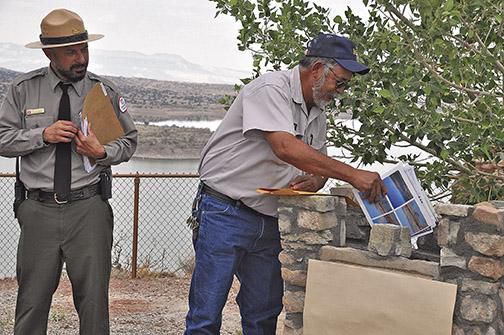
A time capsule to be opened in 25 years was sealed. It contained brochures and photographs of Abiquiú Lake and Dam. It also holds a packet of native seeds, a Corps Ranger patch and a commemorative coin placed by Gant.
The future of Abiquiú Lake and its role in providing flood control, jobs, water resources, electricity and recreation for Rio Arriba County will likely continue, as well as change and evolve for those next 25 years as it has in its first 50 years.