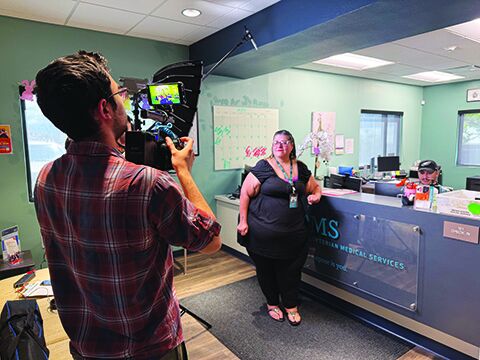
Lupe Sanchez’s struggle with addiction began at 11 when her sister introduced her to cocaine. By 14, she was using Percocet, oxycodone and smoked heroin; and at 16, she resorted to injecting heroin when smoking lost its effect. Sanchez’s 20s were marked by homelessness, jail and multiple stints in rehab.
“You’re sick, your skin’s crawling, you’re sweating, your body’s jerking and you have no control over it, so you stop at nothing to get better and to feel well,” Sanchez said of days lost in the fog of addiction, searching for the next high. “When you’re in active addiction, everyday is rock bottom.”
Now sober, Sanchez is sharing her story as part of an opioid prevention campaign led by a collaboration between the Rio Arriba County Health and Human Services Department, Hands Across Cultures and filmmaker Harry Gantz who directed a recent film project. The campaign, released on July 15, uses a series of videos to address opioid misuse, highlight recovery resources, amplify the voices of those affected and offer a pathway to healing.
The campaign features four videos, each tackling a different facet of the opioid crisis. One focuses on seniors using prescriptions safely to avoid overdoses, another showcases local providers offering treatment and support, a third captures youth perspectives through a podcast-style format, and the fourth, a testimonial video, shares stories of individuals, like Sanchez, who are in various stages of recovery.
The videos were set to premier at the Rio Arriba Community Health Council meeting on July 15 at McCurdy Ministries and went live online the following day.
Diego Lopez, a producer on the project and a native of Española, emphasized the effort to connect resources with those who need them most — a main goal of the campaign.
“Sometimes there’s a disconnect from the people who are providing services to the people who actually need the services,” Lopez said.
Dr. Ahmed Dadzie, director of the Rio Arriba Health and Human Services Department who also was a producer of the film series, described the campaign’s data-driven approach.
“What we’re doing is we’re engaging in primary research to be able to identify the driving factor, or factors, impacting substance use, and from there, we’re coming up with interventions to better address these variables that were identified,” he said.
Lopez and Dadzie both cited the county’s addiction overdose rates as a key motivator for the campaign.
“Just go down Riverside Drive, you see the impacts that it (opioid addiction) has,” Lopez said. “It’s affected all of us in a profound way.”
The team conducted focus groups and incorporated input from those with lived experience to ensure authenticity and reliability of the films. One video, directed at seniors, recreates the true story of a woman who overdosed on her prescription medication.
“We re-told that story with local actors and recreated that as an awareness piece,” Lopez said.
Another, a podcast-style video filmed at Northern New Mexico College with Upward Bound students, offers raw insights into youth perceptions of drug use.
“They’re telling us exactly what they see, what they feel, what’s going on in the schools,” Lopez said, who described the experience as “eye opening.”
The provider-focused video highlights local resources like Presbyterian Healthcare Services, Darrin’s Place and Delancey Street Foundation, addressing mental, physical and social services needs. The testimonial video was deemed so powerful by those who worked on the project, that it’s being submitted to the Santa Fe International Film Festival. It features individuals on their recovery journeys. For Sanchez, sharing her story was an opportunity to use her journey to sobriety as a way to uplift and inspire others to do the same.
“Maybe my story will be something that somebody needs to hear, to know that there’s hope and that you can come out of the darkness into the light,” she said.
Pregnancy was a turning point for Sanchez. At her lowest, she recalled nodding out while high and pregnant, burning her belly with a cigarette.
“The guilt and the shame that I felt in that moment was … I think that’s what did it, that was the moment of clarity for me,” Sanchez said. “Like, you know, look at you, you’re disgusting.”
With the help of methadone, a medication-assisted treatment, Sanchez stabilized and has been sober for years.
“It’s evidence-based, you know, evidence based that it works,” Sanchez said of MAT, urging an end to its stigmatization. “I wish people would stop stigmatizing it, because it does work.”
Sanchez now works as the medical services manager at the Santa Fe Recovery Center, helping others climb out of the black hole of addiction. Her daughter is now 7 years old.
The campaign’s personal stories underscore its mission to humanize the crisis. Dadzie highlighted the importance of including those with lived experience.
“Utilizing people with lived experiences can help build connection, and from building that connection, then persuasion can be utilized to convince whoever it is that we’re trying to convince to engage in recovery,” he said.
Youth perspectives, too, struck a chord. Dadzie recalled a teen’s description of living in Española as being an impending doom, whereby you never knew when you were going to be addicted to opioids.
“They talked about how you can’t go a week without somebody offering you substances,” Dadzie said. “I thought that was really heartbreaking and sad to hear.”
For Sanchez, the campaign is a beacon of hope.
“I just want people to know that there is hope, there is help, there is no judgment,” she said.
Her journey from addiction to advocacy embodies the campaign’s message that recovery is possible and community support is key.
“Even if it saves one life, that’s a life,” Lopez said.
For more information on local resources, contact the Rio Arriba Health and Human Services Department at 753-3143.