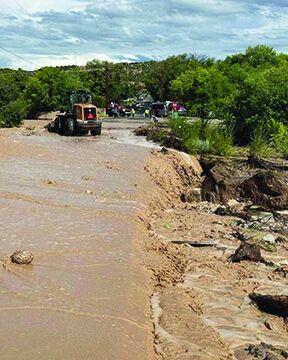
The Rio Arriba County Commission has declared a state of emergency after flooding caused corrosion and damage to acequias in the area.
During the Oct. 24 regular County Commission meeting, County Manager Jeremy Maestas presented Resolution 2026-030, declaring a state of emergency for acequias in Rio Arriba County. It passed 2-0, by District II County Commissioner Alex Naranjo and District III Commissioner Moises Morales Jr. District I Commissioner and Board Chair Brandon Bustos was absent.
The resolution said it’s necessary to declare a state of emergency because of many acequias in Rio Arriba County were severely impacted by heavy rainstorms that created flash flooding that began on Sept. 30.
“… These acéquias were so severely impacted that the Rio Arriba County Commission now recognizes an imminent and proximate threat to public health from the severe damages resulting from the flash flooding events …” the resolution said. “… All local resources available have been insufficient to cope with the resulting damages resulting from the flash flooding events …”
The purpose of the declaration is to “authorize the exercise of necessary emergency powers and expenditure of available resources, as well as the requesting and accepting of aid, assistance, relief programs, and funding that may be available from the State of New Mexico, federal government and others. It authorizes Maestas to apply for and accept aid, assistance, funds and relief.”
Maestas said rain at the end of July caused catastrophic damage to acequias in Chimayó, La Madera, Ojo Caliente and Hernandez.
“We are working diligently with homeland security and emergency management to identify how we can help acequia associations because the amount of damage is significant,” Maestas said at the meeting.
Naranjo asked Maestas who would be responsible for the repairs and who would get the money.
“When you get approved for a declaration of emergency from the state, you get reimbursed for the costs by the state,” he said.
However, he pointed out that the local acequia associations have minimal funds and can’t provide the money necessary for repairs, up-front. Maestas said Santa Fe County is also participating in the emergency declaration since some of the acequias in the Chimayó corridor fall in Santa Fe County.
“I met with a lot of people from different acequias,” Naranjo said, following the presentation.
He said there are more than 300 acequias in Rio Arriba County and he hopes the acequia associations can somehow consolidate what they have in mind for Rio Arriba County.
“I hope they all get together as a board to calculate the money it will cost for the repairs, then divide it,” Naranjo said. “That’s my mentality.”
Maestas said the associations in Chimayó got together, and so did the associations in San Pedro, and put together a cost for the different acequias. However, each sustained varied amounts of damage.
“Chimayó sustained a lot more than the one in Hernandez,” Maestas said. “The one in La Madera sustained different damage than other parts of the county. They can’t do it together because they have different needs.”
He said that once the resolution is passed, the county can “get with the acequia associations and look at different pots of money that are available.”
The cost for repairs to each acequia is substantial. Maestas shared a copy of the Ojo Caliente Acequia Disaster Chart for summer of 2025, when asked about the costs of repair. The total estimated damage cost for that area is $8,495,527.25. That includes repairs for Acequia de la Mesa Prieta, La Acequia del Gavilan, Acequia de Los Gallegos aka Ojo Caliente Ditch, Sanchez-Lucero-Trujillo, Gallegos-Jaramillo Ditch, Rio Tusas, Acequia de los Chaves, Acequia de la Jarita, Acequia La Madera, Acequia de Los Ancones and the Vallecitos East Ditch.
Meanwhile, the Santa Cruz Acequia Disaster Chart for Summer 2025 lists the following ditches: Cinco Acequias, Acequia de los Garcia, Acequia de los Ortega, Mesilla Community Ditch Association, Acequia de los Herrera and Acequia de La Lomita (shared damages), Sombrillo Community Ditch, Acequia de la Santa Cruz and Acequia de El Llano (shared damages), Acequia de los Fresquez, Acequia de los Martinez Abajo, La Puebla Community Ditch, Acequia de los Martinez Medio, Acequia de los Espinosa, Acequia de los Ranchos, Acequia del Potrero, Acequia de los Martinez Arriba and Distrito Community Ditch, Acequia de la Cañada Ancha, Acequia de la Otra Vanda and Acequia Sur del Rio Chiquito.
The total estimated damage cost is $2,764,386.85 and like the Ojo Caliente list, includes debris removal, diversion of dam or headgate, reconstruction of acequia blowouts and bank stabilization, among other damage.
Naranjo said the repairs in Chimayó, for example, will be very costly.
“We don’t have the resources to help them unless they get funding from the state,” he said.
In an email on Monday, Maestas said the county’s partners at the New Mexico Acequia Association have identified a preliminary list of affected systems on the Ojo Caliente and Santa Cruz lists, but they recognize there may be additional acequias throughout the county that have not yet been assessed.
“We understand how vital acequias are to our residents, our agricultural community, and our shared heritage,” he wrote. “The lack of this access to the water poses a serious challenge to our farmers, ranchers, and others who depend on these systems for their livelihoods.”
Maestas wrote that the county “has been working closely with local acequia associations, state agencies, and our emergency management partners to evaluate the full scope of the damage and identify the necessary repairs.”
“We are hopeful that the New Mexico Department of Homeland Security and Emergency Management will be able to assist us in identifying funding sources to help these acequia organizations bring their operations back to normal as soon as possible,” the email said.
He said it’s too early to provide a definitive timeline for repairs, but they hope the acequias are properly funded and restored to working condition by next spring, when they are most needed.
“We understand the serious role these systems play in the lives of our constituents and we are all hopeful for the best possible outcome,” Maestas wrote.