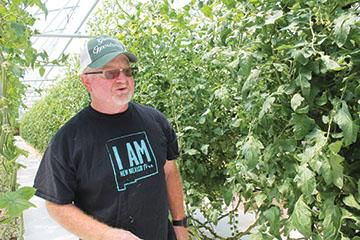
Steve and Kim Martin have been growing tomatoes and cucumbers for nearly 18 years using hydroponic techniques. They say the process requires attention to detail and constant upkeep, but the rewards include more flavor, a better appearance and a longer shelf life.
Steve was a fourth-generation dairy farmer in Madison County, New York, outside of Syracuse, for most of his life up until the 1990s, before turning to the type of farming he does today.
“I was running around in the barn with diapers,” Steve said. “Farming was ingrained in my blood, so I wanted to stay with farming and have a home-based business, which this creates for us.”
Today, the Martins raise English cucumbers, cherry tomatoes, beefsteak tomatoes, 10 different varieties of heirloom tomatoes and mint and watercress on their seven-and-a-half acre property in Los Luceros on the east bank of the Rio Grande.
In the 1980s, Steve studied engineering at the University of New Mexico–Los Alamos, but quickly dropped out and became the maintenance manager for the school, before going back East to become a truck driver and continue helping on the family farm.
“By the late 1990s, I didn’t want to dairy farm anymore, I just couldn’t make it anymore,” he said. “We never grew a tomato in our life, we just jumped into it, made all the mistakes and somehow, we’re still here.”
He returned to Northern New Mexico because he knew the weather would be better for farming than Syracuse.
“It’s so cold back East,” he said of the struggle to sell tomatoes. “There’s so much snow, I couldn’t even get people to commit to 80 cents a pound. Our lowest price here is $2.50 for wholesale.”
Kim is originally from Virginia, and had no experience with farming prior to meeting Steve in Santa Fe, in 1999.
“I had no green thumb whatsoever,” she said. “I would kill cacti if I tried to raise them, so I married into farming. Now, I understand how the plants speak to you. I respond accordingly to what the plant is telling me. So yeah, I’ve come a long way.”
Steve joked that he suckered Kim into farming.
“I needed labor,” he said.
Marriage
and business
weather the storm
Since the beginning, the Martins say they have capitalized on each other’s strengths to keep the business going. Steve handles the growing and manages employees, while Kim does sales and marketing.
Steve spent two years researching how to raise hydroponic tomatoes before he bought the property and started building the facilities in 1999, with technical support from an Ohio-based company called Cropking.
It would be another seven years before the Martins hired anyone to help them. After the 2007-2008 financial crisis and the subsequent recession, they were faced with the choice of either selling the farm or expanding to stay in business. Now they have six people working under them, and they just hired another to manage all the employees.
“If it was easy, we wouldn’t be doing it,” Steve said. “People get into this business and think, ‘Oh, we’ll just plant the seeds and pick the tomatoes.’ No. It’s all physical work and the only way I felt we could get started was to do everything ourselves.”
Since they built the second of three greenhouses in 2005, they have never been out of production. Two years later, they got married.
“We both need a challenge in life and this is one hell of a challenge,” Steve said.
When asked what it’s like to work together on a farm for 17 years and be married for nine, Steve grinned, and said it’s extremely difficult.
“That’s why we have separate greenhouses,” Kim said.
The larger greenhouse is 9,200-square-feet and the other two are about 3,000-square-feet, each. All three have a cooling system on the back wall that looks like a giant radiator, which cools and humidifies the air inside.
Steve said farming in a controlled environment will effectively future-proof the production against climate change.
“I don’t have to worry about any weather,” he said. “Outside disease, pressure, weather, rain, or frost. It can hail, do whatever it wants. It’s not going to bother a thing.”
When it comes to hydroponic-style farming, Steve said the United States, as a whole, is behind other countries like the United Kingdom, the Netherlands, Israel and Canada.
“We really believe in the hydroponic system because we expect water to become very scarce in the future,” he said.
A little help
from nature
Stepping into one of the greenhouses, visitors must go through a set of airlock doors designed to prevent pests from being sucked into the building by the air conditioning.
The farm’s 500 plants are in a constant battle with white flies that eat leaves and secrete toxic saliva and honeydew (not the fruit) that promotes mold growth. Rather than use any pesticides or other chemicals to combat them, the Martins have a contingent of predatory wasps, what they call a beneficial species, that seek the white flies’ eggs and lay their own eggs inside, which kill the pests before they hatch. A population of lady bugs also helps control pests.
“It doesn’t work like pesticides,” Steve said. “But you’re not trying to eradicate them completely. There are good bugs and bad bugs, you’re just trying to maintain a balance.”
Every six weeks, they buy a new hive of bumblebees, which they say do a better job of pollinating than humans ever could.
One airlock doubles as a control room, with a computer connected to environmental sensors all over the farm.
The Martins use this to track sunlight, air quality like humidity and carbon dioxide levels, and weather forecasts across any period of time.
From this small site, Kim oversees deliveries throughout New Mexico, to all but two of the Whole Foods stores in the state, food co-ops and Farmers Markets in Española, Taos, Santa Fe, Albuquerque and Los Alamos, as well as various restaurants in Santa Fe and Albuquerque
For seven years, Josh Novak has been buying green tomatoes from the Martins for his menu at The Hollar in Madrid, where he is owner and chef.
“With their tomatoes, there are fewer bugs than with conventionally-grown, and they’re always juicy,” Novak said. “Even green tomatoes, when we fry them, they always seem more flavorful. I sell 80 pounds of fried green tomatoes a week, because they are superb.”
Steve calls the beefsteaks their staple item, and the very first crop they started with in 1999. Beefsteaks were the only tomato they grew for the first five years because they yield two- to three-times as much weight as heirlooms.
However, with the hydroponic process, the Martins are able to produce the same amount of heirlooms and beefsteaks using the same amount of water.
“We would be stupid not to offer diversity,” Kim said.
Every year, Steve said, they use three acre-feet of water, or about 977,000 gallons, to produce an average of 125,000 pounds of tomatoes.
The farm’s groundwater is pumped through a sand filter and an ultraviolet chamber that kills bacteria, then it goes into a system that adds nutrients for the plants.
Proper nutrients
The right mix of nutrients requires zinc, copper, iron, boron, manganese, calcium nitrate, potassium nitrate, magnesium sulfate, potassium sulfate and monopotassium phosphate. Despite not using any pesticides, this process means the produce is not, technically, organic.
“What you put in, you get out of it,” Steve said. “We force our nutrients really, really hard, so we have flavor. I force it so hard, we have problems.”
Early on, when Steve was still learning how to use the nutrient system, he mixed the sulfuric acid wrong and killed the plants’ roots, losing two months of production.
Every week, they do tissue analysis of a sample tomato to make sure the nutrient mix is correct. The water from the farm’s well has a natural pH level of 6.9, and the mix makes it more alkaline, to about 5.8.
The tomatoes and cucumbers begin as seeds placed into the center of a sterile rockwool cube that is about 1.5-square-inches. After 10 to 12 months of growth, the vines will be 25-feet-long.
Rockwool is a mix of rock and sand that is super-heated to 1,800 degrees Fahrenheit, then spun into fiber like cotton candy, Steve said.
The rockwool cubes are placed in holes along a plastic gutter system with four steps.
The nutrient-enriched water falls from the first step with the oldest plants to the fourth step with the youngest plants, into a bucket and is recycled back into the system.
For the tomatoes, no soil is involved during these firsts two weeks, only a small film of nutrient-enriched water than runs along the guttering and is soaked up by the plants’ roots.
The Martins also grow herbs like mint and watercress this way, but they stay on the hydroponic track for a month or so.
After that, the plants are moved into buckets full of soil and ingredients that hold water and oxygen. Those include coconut fiber and perlite, a white ore that has been super-heated to 2,000 degrees Fahrenheit, which makes it pop like popcorn and become sterile and keep a neutral pH level.
The farm limits its water use by automatically adjusting the amount of water sent to the plants, based on how much sunlight is detected by sensors installed on the greenhouses. Cloudier days means less evaporation, and in turn, less water is needed to keep the plants alive.
Steve estimates they use 30 to 40 percent less water thanks to the the solar sensor.
The height of production is from April to July. At the end of each summer, the Martins clean out two of the greenhouses and start again with new plants.
Then at the turn of the new year, they do the same with the third. Typically, they don’t have enough product to distribute to Albuquerque and Taos in the winter.
“The older the crops get, the harder they are to manage,” Steve said. “You get more bugs, more disease pressure.”
Kim said they’re like people and they start to break down.
Steve used to get on stilts to cut the extra growth off of the vines called “suckers.” If left unchecked, the new vines would extend between the rows and tangle the entire greenhouse.
With age, Steve’s legs developed weakness and pain, and the stilts now lay in a corner in one of the greenhouses. These days, he drives a trolley between the rows, which raises him above the seven-foot-tall canopy to cut away the unwanted growth.
From vine to plate
About 90 days after the tomato seeds are placed in the rockwool cubes, the vines will start to bear fruit.
Every Tuesday and Friday, it’s all hands on deck to collect the tomatoes ready to be picked. In the beginning, the Martins would carry them in old wooden bottle crates or in blankets. Eventually, Steve wanted to make the picking process easier, so he used some extra greenhouse parts and his amateur welding skills to create metal carts which hold large plastic crates, to carry the produce.
“We used to hand-cart any debris out to a pile in the back,” Kim said. “One of the best investments we’ve made was a Bobcat 4×4 with a hydraulic dump trailer. Now we just drive that.”
Cucumbers are much harder to cultivate, Steve said, and must be picked every day because they grow so quickly.
The tomatoes are weighed and sorted into 10-pound cardboard boxes, which are then stacked up to four-feet tall to ripen in a small, climate-controlled warehouse for about a week.
The most ripe tomatoes sit at the bottom of the stack and the least ripe ones sit atop the rest, and as heat rises, they ripen more evenly.
“We just let them sit here and ripen naturally,” Steve said. “We don’t hit them with ethylene gas or anything like the big guys.”
The cull, the tomatoes that are too soft or have blemishes, are often bought by restaurants to be made into sauces.
Chef Nathan Mayes has been using the Martins’ cull to make ketchup and has been pickling cucumbers for hamburgers and other sandwiches for five years, at the The Betterday Coffee Shop in Santa Fe.
“Living here in Santa Fe, our growing season is very short for tomatoes,” Mayes said. “Having someone growing them year-round in a controlled environment, producing a uniform fruit, gives us access when we can’t have it otherwise.”
Mayes prefers the taste of conventionally-grown tomatoes, but he said nine times out of 10, good flavor comes out of a tomato when the plant is properly cared for.
He had no doubt about how the Martins look after their crop.
“Kim has a great product,” he said. “I can’t wait to get the next delivery.”
Kim said there is something about the job that makes it feel bigger than just selling a product to customers.
“I have customers at the Farmers Markets that I consider friends more than customers,” she said. “That’s the type of relationship that we have cultivated over the years. That’s one of the best parts of doing all of this.”
Novak said despite not knowing the Martins very well, he still feels very close to them.
“They’re fantastic people,” Novak said. “I honestly treat them like good friends, they’re like a family to us. They grow a very, very good product that’s the most consistent I’ve had, out of any restaurant I’ve worked in or produce I’ve ever gotten.”
No signs
of stopping
The Martins, despite being very aware of their age, are optimistic about the future and show little sign of slowing down their production any time soon.
“We’re always tired, but we’re always having fun,” Kim said.
The farm is currently in the process of upgrading its electrical system for the existing buildings, and the Martins have infrastructure in place for two more greenhouses, if they want to expand even more.
“Starting something with seed and watching it grow, and watching it bear fruit, and become this huge, wonderful, magnificent plant, offering all of those different colors, all those different varieties, that’s what I get out of it,” Kim said. The gratitude that people have for what we’re doing, and seeing the expressions on people’s faces when they eat our tomatoes, is the best benefit ever.”