Learning the Code

Published:

No matter their age, people use electronics. From toddlers playing with iPhones, to five-year-olds competently navigating through movies and games on the Internet, everyone seems to be interested in technology.

    To use these products, most people learn through trial and error or opting to watch or read a tutorial. However, during the week of Dec. 9-13, students around the globe went further and learned what makes software. These students participated in an initiative called the Hour of Code, created by non-profit organization, Code.org.

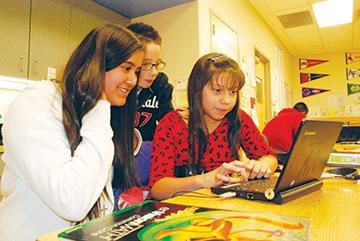
    Among those who took part in the initiative, were Española School District students. Certain classes and grades at Española Middle School, Española Valley High School, Española Elementary School, Chimayó Elementary School, Mountain View Elementary School and Abiquiú Elementary School committed one hour to coding — the heart of computer programming.

    District Technology Curriculum Specialist Felicia Maestas said the District first heard about the opportunity to participate in this worldwide initiative a few months ago. The Hour of Code was not mandatory for all grades in the District, but rather, offered to all teachers as an option, Maestas said.

    The students first are introduced to the initiative by watching a basic how-to video, loaded with celebrities trying their hand at coding. After the short video, the students are sent on their way to code through a variety of different games.

    “Some of the programming the kids will do is through really simple coding software where the kids use blocking,” Maestas said.

    Since code is simply a message to the computer telling it what to do, blocking consists of arranging directional blocks in a pattern to get some computer character from point A to point B, she said.

    In an effort to help the students navigate the waters of the technological future, Sarb Nam Kaur Khalsa, the beta test manager for Joti Software, along with other Joti Software employees and developers and volunteers from Los Alamos National Laboratories were present. However, oftentimes, Khalsa found all she had to do was step away from the students and let them race ahead.

    “It’s amazing to watch how some of the students get it and they just run with it,” Khalsa said.

    She is an advocate for children learning how to do computer programming. She has been able to write software literature from her house and her son is able to live at home and create apps for phones, Khalsa said.

    “The skill of computer programming is good for our overall economy, because it can be done from anywhere,” Khalsa said.

    Tim Salazar IV is a sixth-grader at Española Elementary School. His teacher Jimmy Lara said Salazar is extremely interested in computers and programming. Salazar is on the hydrogen fuel competition, future city and robotics team. Future city is a national project-based competition, which tasks students with imaging, designing and building cities using software donated to schools in the District, by Los Alamos National Security.

    “Programming is pretty easy,” Salazar said. “It’s basically a way to talk the same language as the computer.”

    Salazar has been working with HTML and CSS. He said he is interested in learning javascript, but has not done so yet.

    He was working with creating shapes of different sizes, color and putting wording on them. Salazar said each line he wrote told the computer to do something specific.

    “Before the Hour of Code, I didn’t know how to do different height and width and pixels for the shapes I created,” Salazar said.

    However, even before the Hour of Code, Salazar had an inclination toward computer programming.

    “I love computer programming and I really want to make my own website and help other people learn how to code,” Salazar said.

    Fellow future city, hydrogen fuel competition and robotics teammate Dulce Maldonado said at the beginning of the Hour of Code, she wasn’t really sure what coding was.

    “It’s technically a demand. It’s me telling the computer what to do,” Maldonado said.

    Maldonado is looking forward to getting more involved with coding and the possibilities offered in the field of computer programming. She said it is definitely something she would consider as a career.

    Other students not quite as devoted to the skill of programming as Salazar, were not left behind with the Hour of Code. Fellow sixth-grader Jolisa Marroquin said she learned to code using the blocking process.

    “At first, I thought this was going to be boring, but after awhile, it was pretty cool,” Marroquin said.

    Isabella Sanchez said she doesn’t like programming as much as Salazar, but she is into it.

    “I want to make my own creation,” Sanchez said.

    She created her own website earlier in the year, but it crashed almost immediately, she said. She is not discouraged by the crash, however. Once she learns more about coding, she said she will attempt to build another website — perhaps as a project for school.

    Lara, their teacher and sponsor for all the technology centered teams, said the students are avid to learn about these topics.

    “I let them at it. I jump out of the way and let them play around with it,” Lara said.

    At Chimayó Elementary School, Kim Avila’s combined fifth and sixth grade class worked through the Hour of Code. Maestas and Khalsa were there to help the students think through the coding process and learn how to communicate a variety of commands to the computer.

    “It was really cool,” sixth grader Savannah Olivas said, after the hour was over. “I learned how to talk to everything that’s actually in the computer.”

    Fifth-grader Isaac Romero said he thought it was fun.

    Sixth-grader Angel Martinez said she was enjoying it because, “It gets my brain thinking more.”

    Fifth-grader Damian Martinez really took off with the programming and decided to race his fellow students, to finish the programming game first.

    “It’s pretty exciting. Right now, the game is neck and neck,” Martinez said.

    Martinez said he was pretty good with computers already.

    “I definitely want to do this for a career,” he said.

    Martinez was the first student to finish the programming game.

    Many of the students who participated in the Hour of Code expressed an interest in continuing to learn about coding. Maestas said because of this, the District has formed a Computer Science Coding Club. The club’s first meeting was Dec. 12 and 11 students showed up. The club is sponsored by Española Valley High School algebra teacher Adam Drew, math teacher Maria Mejia and, to help with the technical computer science aspects, Abhai Raj Singh Khalsa, Hari Singh Khalsa and Fateh Khalsa. All students, no matter their grade, who are interested in computer programming, are welcome to join the club.

Related articles

Recent articles