There are several reasons why the state Education Department wants to revoke the Española Military Academy’s charter at the end of June, but the one that struck the biggest blow at a hearing Monday before Education Secretary Veronica Garcia had everything to do with a lack of academic achievement.
Students are going backwards academically when they enroll in the school, Carlos Martinez, the Department’s assistant secretary for assessment and accountability, testified at the hearing.
“The Academy put students at risk by being there in that their scores might be declining,” Martinez said. “I also need to report that two of the four grade levels tested, in two of those, no student made proficiency.”
Academy officials arrived at the hearing in Santa Fe ready for their appeal and feeling confident. But they did not see Martinez’ testimony coming. The Acadamy’s attorney Patricia Matthews immediately objected to his testimony because she was not notified that he would be providing any testimony.
Martinez’s testimony, referring to extremely low standardized test scores by students, was only part of a three-and-a-half hour public hearing held by Garcia to determine whether the Commission’s Dec. 11 decision to revoke the Academy’s charter was substantiated. She did not reach a decision at the hearing and has until March 4 to do so.
Minutes before the hearing, Academy parent Brenda Lovato and Board President Patrick Trujillo walked into Department headquarters in Santa Fe with a long paper banner that they taped to the wall. The banner read, “A Viable School for the Community,” with a large drawing of the school’s mascot, the hornet, under the words. Lovato said the dozens of colorful stars and squares surrounding the hornet that represented the students, staff and family served as a visual petition for those in attendance. Before the meeting, she felt hopeful but at its conclusion, she admitted she was nervous about the outcome.
The Academy was dealt one blow right off the bat when its accusation that the Commission violated the state Open Meetings Act was resolved before the hearing. Both parties agreed that the date on the letter signed by Commission Chair Catherine Smith informing the Academy of the Commission’s decision to revoke their charter was a typographical error. The letter had been dated one day before the Dec. 11 public hearing.
From the very beginning, Matthews was caught off guard because she did not expect to hear statements from both Don Duran, who represented the Charter School Division, and Roderick Ventura, the Commission’s attorney. Garcia said all three parties involved were to give a 30 minute presentation.
“It sounds like the (Commission) is getting two bites of the apple,” Matthews said. “They’re able to present again the entire recommendation which were made to (the Commission) on their behalf and then they’ll be able to again make an argument in their presentation.”
Duran’s testimony echoed his Dec. 11 report submitted to the Commission. He said the most distressing fact was that 76 percent of the students tested below grade level in reading and 96 percent were below grade level in math. He mentioned that the Academy breached its charter agreement with the Española School District when it changed its curriculum without prior approval from the Española School Board.
Matthews joined Trujillo, Headmaster Steve Baca and business manager Deanna Gomez for the Academy’s presentation. Matthews said the Academy was not given enough time to rebut Duran’s report before and at the Dec. 11 hearing. The report was submitted only three business days before the meeting and the Academy was given only a 10-minute window to rebut the report at the meeting.
Responding to the low standardized test scores, Baca said the Academy did show improvement in reading but needed to improve in that area before they could improve their math scores since the students may not have been able to comprehend the test questions.
“Ninety-six percent of my incoming seventh graders were at a beginner’s level,” Baca said. “There is no magic wand, no magic cloak that’s going to help us get these kids to a proficient level in a year or even two years. I need three years. And these are seventh graders that will be in high school in two years.”
The Academy opened in 2004 with sixth through eighth grades. It has added a grade each year and currently enrolls students in sixth through 12th grades.
Baca explained the switch in mathematics curriculum to the E20/20 computerized program from the Saxon Math Program was informally endorsed by the District since it funded training to Academy teachers. In addition, the change in curriculum was a natural progression since the Academy grew to both middle and high school levels. The Saxon program was designed for kindergarten through eighth grade students while the computerized program catered to a middle and high school curriculum.
Other major findings by the Division were that five staff members did not have the appropriate license, and Baca had hired his sister, Estelle Ana Baca, to teach, which could potentially create a conflict of interest. The fact that the Academy gave Baca’s girlfriend a $15,000 contract in August was not mentioned at the hearing.
Garcia pointed out the five staff members without licenses, considered substitute teachers, worked well beyond the time a substitute is supposed to teach.
Baca admitted that four of the five substitutes only had high school diplomas at the time of the Dec. 11 hearing.
With regards to Baca’s sister, the headmaster said his sister would be evaluated by Los Cariños Charter School Chancellor Vernon Jaramillo, who is a former Academy employee. Garcia was quick to point out that a conflict of interest could still arise if a parent brought a complaint to Baca about his sister. Baca contended that, like many other schools statewide, he struggled to find licensed teachers to come work at the Academy and because of that he hired his sister.
With the Academy’s presentation over, Ventura sat down in front of Garcia to present the Commission’s stance. In response to the Academy’s claim of no due process, Ventura quickly pointed out that during the Dec. 11 meeting that Baca, Trujillo, students, parents and even Española School Board member Floyd Archuleta were given a chance to speak.
“This case is about responsibility,” Ventura said. “Responsibility of the (Commission) to make the proper decision as in accordance, that is not arbitrary or capricious, and is supported by evidence. But underlying that it’s about responsibility. Responsibility of the charter school itself. The responsibility of the school to follow along, to follow the charter and also to make academic progress with its students the way it’s expected to.”
Ventura said the Academy violated numerous laws and that the violation of only one law was grounds for revocation. At the time of the hearing, the Academy did not have the proper certificate of occupancy granted by the state Regulation and Licensing Department for their current facility at the New Mexico National Guard Armory.
Ventura also had in his possession the Academy’s Employee Handbook that the school turned in with its original renewal application. He said the handbook contained language that discriminated against gender, and detailed admission requirements to the Academy which violates state law.
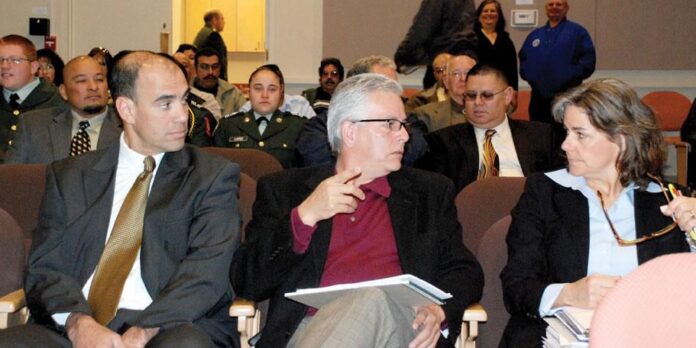
With the hearing’s conclusion, the Academy’s side of the room felt somber. Baca, Trujillo, and Matthews declined to comment about the hearing. The cadets in attendance posed for pictures taken by their parents in front of the banner knowing that they’ll have to wait a few more weeks for Garcia’s written decision.