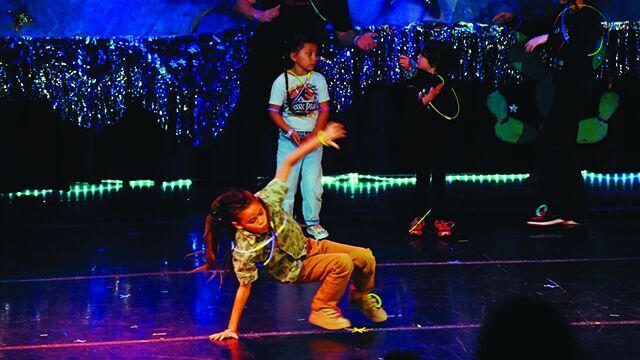
The documentary “MOVING ARTS | Setting Hearts Ablaze,” has been named a finalist at the Cannes World Film Festival, a recognition that has left its co-founders, Roger Montoya and Salvador Ruiz-Esquivel, humbled and inspired.
“It is beyond words, that recognition internationally … it’s hard to explain,” Moving Arts Executive/School Director Ruiz-Esquivel said. “Immediately, we got chills when they told us.”
For Montoya, the program’s artistic director, the international recognition underscores the impact of his work.
“It’s been utterly humbling and heartwarming to the point of almost tears, because we do the work day in and day out,” he said.
The film celebrates Moving Arts’ 18-year legacy of healing youth and families through artistic endeavors in the Española Valley and premiered July 23 at The Lensic Performing Arts Center in downtown Santa Fe,.
The Cannes recognition highlights the global resonance of Moving Arts’ mission, which began nearly two decades ago to address a need in Northern New Mexico.
“We saw that there was a void within the valley, as there were hardly any after-school activities for the kids,” Ruiz-Esquivel said. He met Montoya while teaching in an arts program at a local school, and together they founded Moving Arts to offer accessible, creative opportunities.
“The ones that could afford to go to Santa Fe were the only ones that were taking advantage of taking art classes — and it’s what prompted us to found something to be able to give these kids an opportunity,” Ruiz-Esquivel said of the need for an arts program in the Valley.
Starting with a few classes in collaboration with Española Public Schools, the program expanded as parents requested more offerings like guitar, visual arts and gymnastics. Today, Moving Arts serves up to 300 children daily, across seven studios in a 16,000-square-foot facility, fostering dance, music, visual arts, film and more.
At its core, Moving Arts operates on the philosophy that “art is medicine.” Montoya said. He is a movement artist, painter and choreographer who previously had careers in Los Angeles and New York City and discovered healing through creativity after returning to New Mexico in the late 1980s.
“It was really this notion of settling into my art,” he said. “It’s a place of self-reflection that slows the heart rate. It slows the mental processes in a place where you can actually think and feel.”
The transformative power that art has on youth and adults alike gave birth to the program’s tried and tested ethos, he said.
“You see this kid excited, wanting to be here, wanting to participate, because he accomplished something on his own, because he gained self esteem by trial and error. It just is a cure,” Ruiz-Esquivel said. “It’s where we came with the definition that art is medicine, because art heals one way or another.”
This philosophy drives the program, helping youth overcome challenges and build self-esteem by offering the freedom to freely express their innate and learned creativity.
The documentary, produced by DocuFilms, a Santa Fe-based nonprofit, captures this healing process. The project began when a donor introduced Montoya and Ruiz-Esquivel to DocuFilms’ co-founder, Ruiz-Esquivel said.
“When they came and saw the program, they just were blown away with the facility, what we were able to do with the space that we had,” Ruiz-Esquivel said.
Over nine days, a 20-person crew, led by producer Michael Campbell, captured the atmosphere at the Moving Arts headquarters.
“Moving Arts is a rigorous place,” Montoya said. “Creative, controlled chaos is one way to describe it because there’s seven studios simultaneously going on in 16,000 square feet.”
The filming process prioritized authenticity, starting with shots of the empty facility which is decorated with an abundance of art.
“They were inspired,” Montoya said. “They actually set up a place where they could first film the entire space without humans, because they thought that the container itself … just wanted to talk.”
The crew then documented students and mentors, focusing on authentically capturing the program in its natural state. The filming of the documentary also provided an opportunity for youth in Moving Arts film class to shadow the professionals. The 35-minute documentary highlights most of the program’s offerings, though flamenco and culinary arts were featured less due to time constraints, Montoya said.
The premiere at The Lensic showcased the film alongside a live performance by 49 artists, ages 5 to 83, celebrating the youth who drive the program.
“We’re expecting the children to be recognized for what they do, or what they overcome, and for what they accomplish and what they’re capable of doing,” Ruiz-Esquivel said. The event aimed to deepen public understanding of Moving Arts’ impact.
“One of the things that we would like to accomplish is for people to understand who we are,” he said.
Moving forward, Moving Arts is focused on securing a large facility in Española because they have outgrown their current 16,000-square-foot facility.
“We’re looking into our forever home, a home that we will have on our own to be able to expand, to be able to build up comfortably,” Ruiz-Esquivel said.
Despite offers to relocate to Taos or Santa Fe, Moving Arts remains committed to Española.
“I want the public to know how beloved Española and this valley and our families are, and that our staff is fueled by their beauty and their potential, and that we will not abandon our people,” Montoya said.