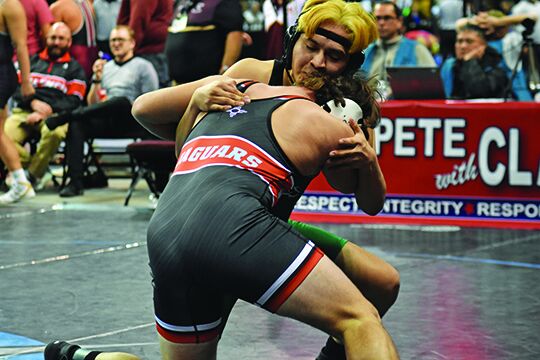
More athletes will have an opportunity to vie for individual state championships in wrestling after the New Mexico Activities Association recently adopted new weight classifications for boys and girls.
Under the new classifications, boys and girls will compete in 14 weight classes, which the boys had three years ago before the limits were reduced to decrease forfeits.
“While it could be argued the state event has seen an increase in competitiveness, overall, the reduction does not appear to have had its intended effect,” according to the agenda packet rationale presented at the NMAA’s commission meeting last month.
Likewise, 14 classifications bring the state in line with neighboring states that use that number.
“Increasing weights will alleviate logistical issues during interstate competition and afford teams, with the ability to do so, the option to provide additional varsity opportunities,” the rationale included.
Nearly 60% of the 64 respondents approved of the 14 classifications, among them Española Valley’s Gilbert Sandoval.
“I think it’s a good thing,” he said. “I voted for it when we did our poll at the end of the season. It works out better being able to have extra weight classes. It’s really hard to cut weight, Sometimes somebody is already at a weight limit, but they’re one pound away from it. A pound is a lot when you’ve got no body fat.”
The girls will be moving from 12 classifications to 14, with increments starting at 100 pounds and going up five pounds until 155, before jumping to 170, 190 and 235-plus.
“When girls’ wrestling was initially sanctioned, 12 weight classes were initially assigned to girls’ wrestling due to limited participation numbers,” the rationale included. “However, due to the continual growth in girls wrestling, especially at the lighter to middle weight classes, an increase in weight classes is appropriate.”
Girls wrestling has grown from 115 participants when it started in 2018 to 835 this past season, NMAA data showed, which was another reason for bumping the number of weight classes.
Additionally, the new classes fit in where the growth seems to be the most prevalent, it said.
And that is important, Sandoval said.
“I think it will be easier to fill the weight classes,” he said. “Sometimes we have two or three girls that all weigh about the same so now we have a better opportunity to fill it out.”
In another issue, the commission discussed but took no action on the possibility of splitting up Class 1A and Class 2A into separate classifications for cross country, an issue that Mesa Vista High School coach Ben Sandoval has lobbied the NMAA to do for many years when he was at Legacy Academy, and his teams would regularly be the top 1A school but receive no recognition.
It would create several benefits, he said, primarily by developing more opportunities for athletes to be honored for their efforts.
Class 1A schools have little chance against the 2A schools, he pointed out.
While individual athletes from the smaller schools can break through with a standout effort to land a podium spot, it’s increasingly rare for a team to do so.
While Sandoval said he does not plan to overtly advocate for the change as he has done in the past, he certainly would support it if NMAA sought his opinion on the issue.