Nestled on the back roads of Lower San Pedro, is an international enterprise.
Lee Goodwin joked about it, but his seed operation has attracted the attention of farmers as far as Europe and South America.
The 63-year-old retired Los Alamos High School physics and mathematics teacher has turned his deceptively large plot of land into a hub for growing hybrid crops of tomatoes, corn and much more.
“I didn’t think it would ever take off,” he said about his crops. “You kind of reach a tipping point where your name becomes well-known, and you’re well-known as a breeder. That seems to be kind of where I am now.”
A one-man operation, J&L Gardens is not only a veteran of the local Farmers Markets, but a go-to source among customers, farmers, restaurants and even researchers for innovate, in-demand and specialty crop and seeds.
The operation
Goodwin, who moved onto his property 27 years ago, with his wife, Maryellen, didn’t start producing seed varieties until four years ago.
“I said, ‘I’m going to do the seed business and see where I could take it,’” Lee said. “I had a number of new varieties I could release, so I’ve been working all of these summers.”
Having grown and sold crops at the Santa Fe Farmers Market for the past 15 years, Lee began to collect various seeds from different resources and grew a large variety of tomatoes.
“It caught on,” he said. “People wanted something new, something different, different colors and flavors. They were willing to try it.”
While tomatoes have been Goodwin’s best seller to Farmers Markets customers, the demand for his seeds has taken off in the last year-and-a-half.
“The first year, I sold exactly one packet of seed, but I had my name out there,” Lee said, noting he would give early buyers a few extra seed packets. “Before you knew it, people were ordering. It’s just word of mouth.”
With an estimated 150 different types of seed on hand for tomatoes, chile and peppers, Lee stores them in a room adjacent to his garage, where all are meticulously organized, along with cabinets for corn and beans, as well. The temperature of the room isn’t ideal, but he’ll store seeds that will be kept for a longer period of time, in a refrigerator in the room. The variety of seed is continually growing, as he noted the growth of his collection of chile seeds, as an example.
“Even different families in a particular pueblo have different chiles,” Lee said. “It doesn’t take long to get a bunch of chile.”
The growth of the seed production is the next step in Lee’s passion for farming.
The beginning
A native of Durango, Colo., Lee grew up on a small farm before leaving for a job opportunity.
“There’s a time in there where I worked a whole bunch of different jobs,” he said. “Mostly, I was a superintendent on construction jobs in Riverside (California). Then I finally got here, got finished up and started teaching.”
Earning his bachelor’s degree in physics from Western Washington University in Bellingham, Wash., in 1984, he returned to New Mexico, and to school, where he earned a teaching certification at the University of New Mexico in 1993.
“I swore I was never going to teach after watching my dad grade those papers night after night, but I loved that,” Lee said about teaching. “It was good work. It left my summers free to garden.”
Lee began teaching at Los Alamos High School in 1994, where his wife taught, as well. Maryellen, 66, a Nevada native, also grew up in a farming environment before turning to teaching.
“In Nevada, during the early 1950s, we were very much subsistence (farming), we grew our own foods,” she said. “I’ve had my share of farming and gardening.”
The Goodwins purchased a property in Lower San Pedro with a house and orchards surrounded by alfalfa fields.
“I wish we would’ve gotten here a little earlier, we would’ve bought those alfalfa fields too,” Lee said.”
He ran into some hurdles at his property, some expected, some unexpected. With a property sitting on bottomless sand, the short fences surrounding his neighbor’s properties puzzled him.
“I thought, what kind of animals are they trying to keep in? Miniature sheep or something?” he said. “I planted the first fences along the back out here. I realized after five years, they were slowly sinking into the sand.”
Lee has to constantly add organic material to his land, but said it was easy to work with. Grasshoppers, which continue to chew holes into crops Lee has to discard, were an early pest.
“They would strip all the leaves from the apple trees and just hang there in huge clumps,” he said. “It took a few years to bring everything back into balance.”
Now sitting on a fertile land, J&L Gardens is home to some of the most unique crops in New Mexico.
The produce
The soil at J&L Gardens drains well, making it ideal for tomatoes. Surrounded by tomato cages in plots in his own front yard, tomatoes off the vine vary in size, appearance and taste.
Signified by names as unique as their appearance, tomatoes grow in all shades of red, blue, and green, all ripe for the picking during the summer months.
“I sell a lot of the old heirloom varieties of tomatoes and peppers and things like that,” Lee said. “About half of my business is new varieties.”
A quick glance at J&L Gardens’ website reveals among bestsellers, a blue tomato.
“They have as much antioxidants as blueberries, they’re healthy,” Lee said. “I expect you’ll see more variety.”
On the farm, hybrid tomatoes are discernible by their leaves, some wispy, some covered in thorns. Some tomatoes are covered in husks like tomatillos, others full of fuzz.
“It’s super cold tolerant,” Lee said about a small, green, fuzzy tomato. “It’ll go through a hard freeze and it won’t even faze it.”
Smaller plots of both peppers and chile also provide much of the hybrid seed Goodwin touts.
“It doesn’t take a lot of peppers to make seed for the year,” Lee said.
His pepper collection includes those named after rattlesnakes because of the noise they’ll make when full of seed, as well as peppers so hot to the touch, a handler could get blisters.
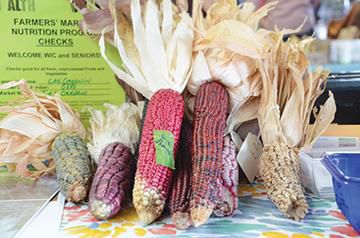
Super sweet corn is planted next to the peppers. It’s a corn hybrid Lee is watching to see if it’ll be stable.
The super sweet corn has a genome that doesn’t convert sugar into starch, allowing it to retain its sweet flavor longer than other corn.
“With these new super sweets, that gene, you have a couple of weeks, you can pick them, you can put them in the fridge for a week or two, they’ll be as sweet as can be,” he said. “I worked on that for a number of years.”
The field to the right of the Goodwins’ abode is home to more varieties of chile, beans and peanuts — a lesser-known crop that has a history in New Mexico.
“They’ll bloom a beautiful yellow flower, it turns over, and it’ll grow into the ground,” Lee said. “Isn’t that wild? They’re good to grow with other plants.”
In keeping his operation as natural as possible, Lee also has a large patch of Buffalo Gourd growing alongside a small ditch, separating his home and field.
“They’re a potent insecticide — they have a very strong fume,” Lee said. “It’s a very strong, stinky smell. That deters insects.”
Some of the Goodwins’ plants also have mesh bags on their blossoms to prevent his small collection of bees from pollinating certain crops.
Goodwin owns a single langstroth hive and is buiding the hive after recently getting a new queen.
“My wife says ‘How come I don’t have more honey?’” he said. “My extractor’s not working like it should be. We get some honey out of them.”
The plants not only thrive because of Lee’s carefully crafted fields, but because of the water he receives from the Ortega ditch.
Commission chair
Lee was talked into taking the position of chairman of the Ortega Acequia, but it doesn’t mean he’ll get preference among the 80 users of the sparse water he helps manage.
“It’s hard keeping the ditches open,” he said. “People throw trash in the ditches, taking the water when it’s not their turn.”
Water, which flows from the Santa Cruz Dam, is released three days a week and is controlled by Tommy Maestas, the mayordomo of the Acequia. One of three members on the commission, Lee will get calls to help with problems in the ditch, although he said the calls don’t usually come.
The Ortega Acequia doesn’t allow transfers, knowing other communities would jump at the opportunity to take water from the ditch. Lee will get water to flow alongside the creek that runs on the south end of his home and understands how valuable the resource is.
“It’s hard to keep it going, kids move off the farm,” he said about the community. “They divide the property where it isn’t viable as a farm.”
Farmers market mainstay
J&L Gardens sold at the Santa Fe Farmers Market as early as 15 years ago, when vendors assembled in parking lots around town. For the last seven years, J&L Gardens has been a reserve vendor at the Market’s new location at the Railyard building.
“If people want field grown (tomatoes) they’ll come to me,” Lee said. “There’ll probably be another six weeks before another farmer comes in with field grown tomatoes.”
J&L Gardens’ table is lined with boxes of tomatoes, along with packets of seed. Still-growing plants sit by one of the building’s openings and will attract customers well before the 7 a.m. start time.
Selling bowls of tomatoes in brown paper bags for $5, as well as handpicked hybrid variety heirloom tomatoes from small crates, Lee is usually one of the first farmers to sell out for the day, sometimes as early as 8:30 a.m.
Preparations for the Market involve Lee picking tomatoes on the Friday before the Market and Wednesdays before Thursday’s Los Alamos Farmers Market, and early trips to ready his reserve vendor table.
“You leave awfully early in the morning,” Lee said. “Get up at 5 a.m., it’s always pretty. You’re in your truck, it’s loaded full of produce.”
Not the only tomato vendor at the Farmers Market, Lee admitted vendors get competitive, although they continue to support each other.
“Somebody will see you growing something and the next year they’ll grow it,” he said. “Everyone gets along and looks out for each other.”
Having sold to certain customers for years, Lee reserves small batches of tomatoes and plants for his customers ahead of time, who make visiting his table a priority.
Arturo Sandoval, a Santa Fe native who lives in Miami, picked up tomato plants from J&L Gardens, June 24, to plant at his summer home in Santa Fe.
“This turned out to be a very nice surprise,” Sandoval said about finding the plants. “They’re late in the year, he had a few. He (Lee) has a very nice product, I buy from him on a regular basis.”
Also among his regular customers are chefs from local restaurants.
Chefs’ preference
“The best restaurants always come around to the Farmers Market, looking to see who’s there,” Lee said. “Buying directly from farmers, they know what they’re getting. They can talk to the customers about the farmer. That kind of connection, people like.”
J&L Gardens’ tomatoes are a preference for Four Seasons at Rancho Encantado Chef Andrew Cooper, as well as a former chef at Arroyo Vino in Santa Fe, who’s since left.
“I’d like to work with him again,” Lee said. “Just because he’s good and he respects the product.”
The Dixie Girl Market in Los Alamos was also a customer of J&L Gardens before it closed. Lee has eaten his tomatoes in dishes at restaurants, although he joked he’d only order on the lunch menu at the more expensive restaurants.
He remembered one gesture that stuck out in his mind, by a restaurant, to show their appreciation for the farmers.
“Rancho Encantado invited all the farmers in for the produce they used,” Lee said. “They had a dinner for us. A bunch of other people came in, too. It was really nice.”
One man operation
Maryellen is hands-off when it comes to the gardens.
“I’m real bossy,” she said, laughing. “Lee kind of needs to be the boss. I think he enjoys it more if I let him do something.”
The “J” in J&L Gardens comes from Jan Cunningham, a family friend and close friend of Maryellen.
“When we first moved down here she came down with us,” Lee said. “She helped us out with this place for a number of years.”
With no farming background, Cunningham contributed physical labor, always willing to take on any task around the garden. Having left Española, Cunningham turned her focus to running triathlons.
“I still call it J&L, but maybe I’ll try L Gardens now, this year anyway” Lee said, laughing. “It probably will be. Jan’s pretty busy, that’s okay.”
Tomatoes can’t be harvested mechanically, making Lee’s operation entirely hands-on.
“I’m so far behind this year,” he said.
The seeding for the tomatoes and peppers began in January, and are now in the midst of picking season.
Once fall comes, Lee will clean the fields by hand before winter arrives.
Along with the field work, Lee manages the shipping and processing of seeds in and out of his farm from his home office, using the United States Postal Service office in Española to deliver seeds across the world.
“They get it everywhere,” he said about the Postal Service. “China, to Indonesia, to Brazil, Great Britain, it gets there with no trouble. Everything comes here.”
With customers from overseas ordering from his website, his international reach has provided some unique relationships during the past two years.
Across the nation and overseas
In an attempt to form a seed exchange, one package caught Lee by surprise.
“That guy from Belgium, he sent me (seed) completely out of the blue,” he said.
The package contained seeds from Belgium for Lee to grow, with the sender requesting seeds from New Mexico in exchange. The request from an overseas farmer has grown more common as J&L Gardens’ seed operation grows. Lee has exchanged seeds with people as far south as Ecuador and as far east as Ukraine and Russia.
Some of the farmers he exchanges with have become friendlier than others.
“I think they’re going to come out and visit this summer,” Lee said about the Belgium farmers.
J&L Gardens has exchanged seeds with universities and shares research with them.
“I had gotten seed from UC Davis, there’s tomato research there,” Lee said. “They have everything, remarkable varieties. I’ve used them for cross-breeding.”
He’s also received cold-tolerant seeds from the University of Alabama. In a more local relationship, Lee is doing a chile project with New Mexico State University.
“Every village had it’s own chile, we’re trying to save as many of those as we can,” he said. “The university collected some, I collected some. There’s a seed blessing in the spring where sometimes I can find seeds for rare chile and save it.”
Corporations will also buy seeds, although Lee said seed producers like him still hold some leverage with their stock of rare varieties.
“I just got somebody like Monsanto who will buy some of my new varieties,” he said. “There’s no way to protect these from use or how they’re going to be used.”
Currently, there exists no framework for property or naming rights on seeds, something Lee wishes existed for farmers like him. When he sells seeds purchased or created from another breeder, he’ll ensure they get a commission from each packet he sells, in what he envisions as an ideal model for the seed market.
“My Chimayó seed from Gloria Trujillo, every packet I sell, they get a dollar of that,” Lee said. “Rose Trujillo from Nambé, she struck a hard bargain. It was two dollars for her Concho beans and chile.”
A future in seeds
With a seed-growing community beginning to develop, J&L Gardens has no intentions of slowing down. At seed blessings in various pueblos, Lee has expanded his seed bank with farmers from across the state.
“I’d like to see more of that,” he said.
J&L Gardens also enjoys the freedom of growing any seed Lee desires, as he noted his international partners may face restrictions in their own countries as to which seed they can produce and how they can use it.
Lee said he enjoys bringing back all varieties of seed to the land, including rare seeds, some which haven’t been grown since the 1930s, and others which have only traditionally been grown on one pueblo or one farm.
“My neighbor here, Bob Hayes, said, ‘Once a dirt scratcher, always a dirt scratcher,’” he said. “It’s in your blood, you love doing it, and you feel like you’re making a difference.”