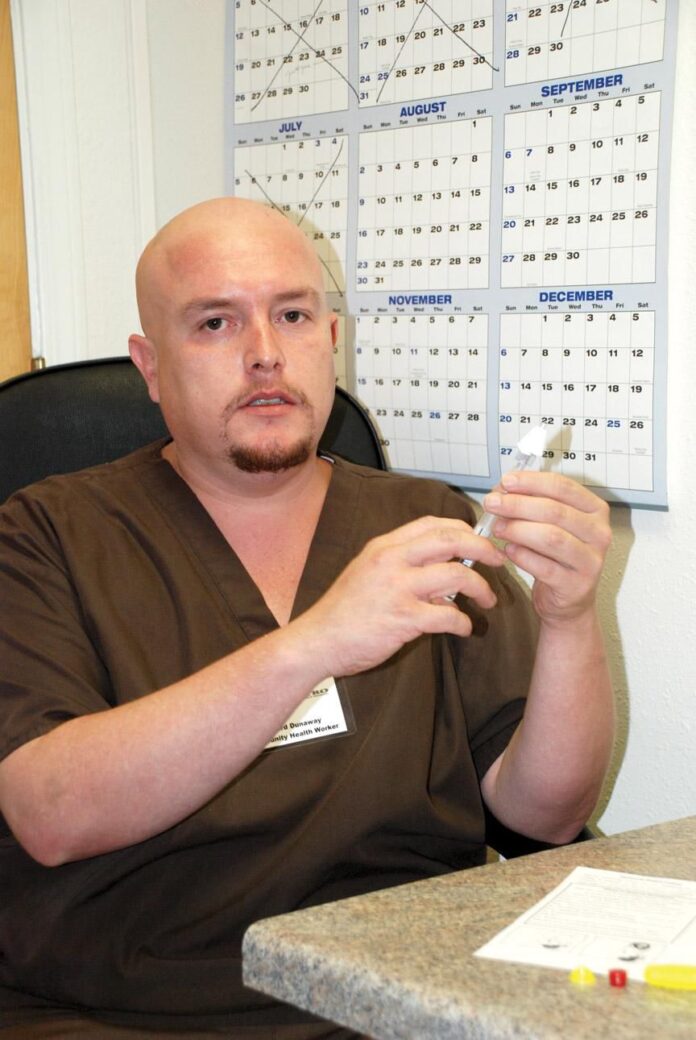
With a rough-hewn pine angel and a tin-framed Jesus staring down from his office wall, El Centro Family Health social worker Edward Dunaway popped the cap off a syringe.
Applicants seeking a new treatment for opiate addictions line up at the El Centro clinic on Paseo de Oñate every Wednesday afternoon to sign up for the clinic’s Suboxone program.
Dunaway is their first stop — the first of three appointments that introduce heroin and pain pill addicts to the program, which combines drug screening and counseling with Suboxone prescriptions.
Suboxone pills contain Narcan, an opiate-overdose antidote, and buprenorphine, a drug that stops opioids such as heroin from attaching to brain receptors, Dunaway tells applicants.
The combination pill has been haled as a “miracle pill” by many patients, including Española resident Ry Parker.
Suboxone frees heroin addicts of cravings and withdrawals, Parker said.
“It allows you to go about your day, to function,” he said.
But patients walk away from their first meeting with Dunaway clutching Narcan, not Suboxone, Dunaway said. They won’t get Suboxone until their third appointment, he said.
“That disappoints a lot of them,” Dunaway said. “Some don’t come back. But if they don’t come back, they’re not ready.”
Dunaway tells applicants how the program works and teaches them how to treat an overdose.
“My role is harm reduction,” Dunaway said. “At the first meeting, I teach them overdose prevention and rescue breathing, and show them how to use Narcan. Three of my patients have saved lives with it over the past month.”
A syringe of Narcan is used like an inhaler, forcing a fine spray of the antidote up each nostril of an overdose victim, Dunaway said,
“You reach more nasal membrane that way, so it works faster,” Dunaway said.
Dunaway helps patients who lack health insurance fill out application forms for assistance from El Centro, which has government grants to help subsidize the program, Dunaway said.
Patients must pay $12 for a urine test to make sure they have not taken benzodiazepines such as Valium or Xanax, he said. “There have been deaths from taking Suboxone with benzos on board,” Dunaway said. “If they’ve taken benzos, they have to wait until they have a clean urine analysis. That usually takes about 10 days.”
The wait can be difficult for people who are addicted to benzodiazepines, Dunaway said. But those who return usually say it was worth the wait, he added.
“Patients call it a miracle drug,” Dunaway said, echoing a phrase also offered by several physicians and recovering addicts.
Suboxone blocks other drugs from attaching to the brain’s reward circuits, Dr. Leslie Hayes, of El Centro, said.
“It hits the same brain receptors as heroin or (opioid) pain pills like oxycodone,” Hayes said. “It curbs cravings but doesn’t deliver enough drug to get high. Taking Suboxone with heroin on board puts you in really bad withdrawals.”
Suboxone is equally effective against heroin and prescription opiate pain pills such as oxycodone and hydrocodone, Hayes said.
But there are other drugs against which Suboxone is useless, Hayes added.
Because Xanax is a benzodiazepine like Valium and Rohypnol, rather than an opiate, Xanax addiction is impervious to Suboxone therapy, Hayes said.
“It’s much easier to treat heroin than Xanax,” Hayes said. “Xanax is an awful drug.”
Suboxone is a long-term opiate-replacement therapy, rather than a quick cure, Hayes said.
Because addicts in Northern New Mexico are surrounded by reminders and temptations, opioid replacement therapy with Suboxone can require two years or more.
“I’ve had patients clean for 20 years come back to Española and see an old friend and go immediately into withdrawals,” Hayes said.
Success rates at El Centro for Suboxone have reached 80 percent, Hayes and El Centro physician’s assistant Debora Newman estimate — once patients have been on the drug for three months, Hayes said. The estimate is based on Hayes’ and Newman’s experiences with patients, rather than a scientific or statistical study, Newman said.
El Centro also uses a more forgiving definition of recovery than some others, Hayes said.
“Success means their life is on track and stay mostly clean,” Hayes said. “Occasional lapses happen. Physicians see addiction as a chronic illness. The goal is to decrease complications and improve quality of life.”
Suboxone overdose is rare. No Suboxone-related overdose deaths in Rio Arriba County were reported by the state Office of the Medical Investigator for 2008. The majority of the County’s overdoses were caused by drugs that can be treated with Suboxone, Office documents show.
Suboxone’s side-effects are rare, affecting fewer than 10 percent of patients, according to federal Food and Drug Administration documents. Side-effects can include headache, pain, constipation, nausea, sweating and insomnia.
Suboxone can also cause occasional, mild stomach upset, according to patients like Parker, 22. Parker started taking heroin when he was 14, he said.
“In this Valley, for some people, heroin’s a coming-of-age thing for men,” Parker said. “I was addicted for seven years. I lost my car, my house, my girlfriend, my dog. I was selling heroin in Chimayo and ran into a big mess. I almost died.”
Parker refused to describe how he almost died, but he said it placed him at a crossroads.
At first, Parker tried to kick heroin by bridging with codeine, he said. That didn’t work, so in November 2007, he came to the El Centro clinic and signed up for the Suboxone program, Parker said.
“Twenty minutes after I took my first pill, I could feel relief, a calm” Parker said.
Two years later, Parker is an electrician’s apprentice and has a new truck, he said. Suboxone helped break Parker’s cycle of addiction, he said. He only occasionally craves heroin now — usually after he wakes up from a dream about shooting up, he said.
“Suboxone helps with self-worth,” Parker said. “The big thing (with addiction) is you feel worth nothing. You get depressed and self-medicate.”
Jail Disrupts
Treatment
Statewide, 116 doctors have already been certified to prescribe Suboxone, mostly in Albuquerque or Santa Fe, according to a federal Health and Human Services website.
Doctors have to take eight hours of training and receive a special federal Drug Enforcement Agency prescriber number before they are allowed to prescribe Suboxone, Hayes said.
Because the Rio Arriba County Jail in Tierra Amarilla does not employ doctors who have taken that training, inmates cannot be introduced to Suboxone.
“Tierra Amarilla is pretty good about continuing Suboxone prescriptions but the jail doesn’t prescribe it,” Hayes said. “And we don’t know when our patients go into jail or come out.”
Nor is there a methadone program in the County jail, Hayes said.
“We’re very frustrated by the problems we have with the jail,” Newman said. “We don’t know when (patients) are released and the jail keeps their Suboxone when they’re released.”
County Jail Administrator Larry DeYapp did not respond to calls for comment.
Patients who kick heroin cold turkey in jail, without methadone or Suboxone, face an increased risk of overdose when they are released, Dunaway said.
“They kick in jail and use the same amount when they get out,” Dunaway said. “So we tell them if they relapse or slip, not to use as much as they’re used to.”
Suboxone is routinely sold on the street in the Española Valley, Hayes and Dunaway said. The same is true in Albuquerque, according to Bruce Trigg, an Albuquerque-based physician who dispenses Suboxone and is involved in the Bernalillo County Jail’s methadone program.
“I’d rather it not be diverted,” Hayes said. “People are using it to bridge until they can get more heroin — not to get high.”
New users sometimes experience a transient “high,” Newman said. But that effect, when it does occur, disappears after the first or second use, Newman said.
When Dunaway started seeing Suboxone program applicants last year, only two out of five would report having tried Suboxone on the street, Dunaway said.
“Now, it’s four out of five,” Dunaway said,. “So Suboxone is out there in the community. People don’t want to go through the malias. They take it on the street, see it works, and some of them come in.”